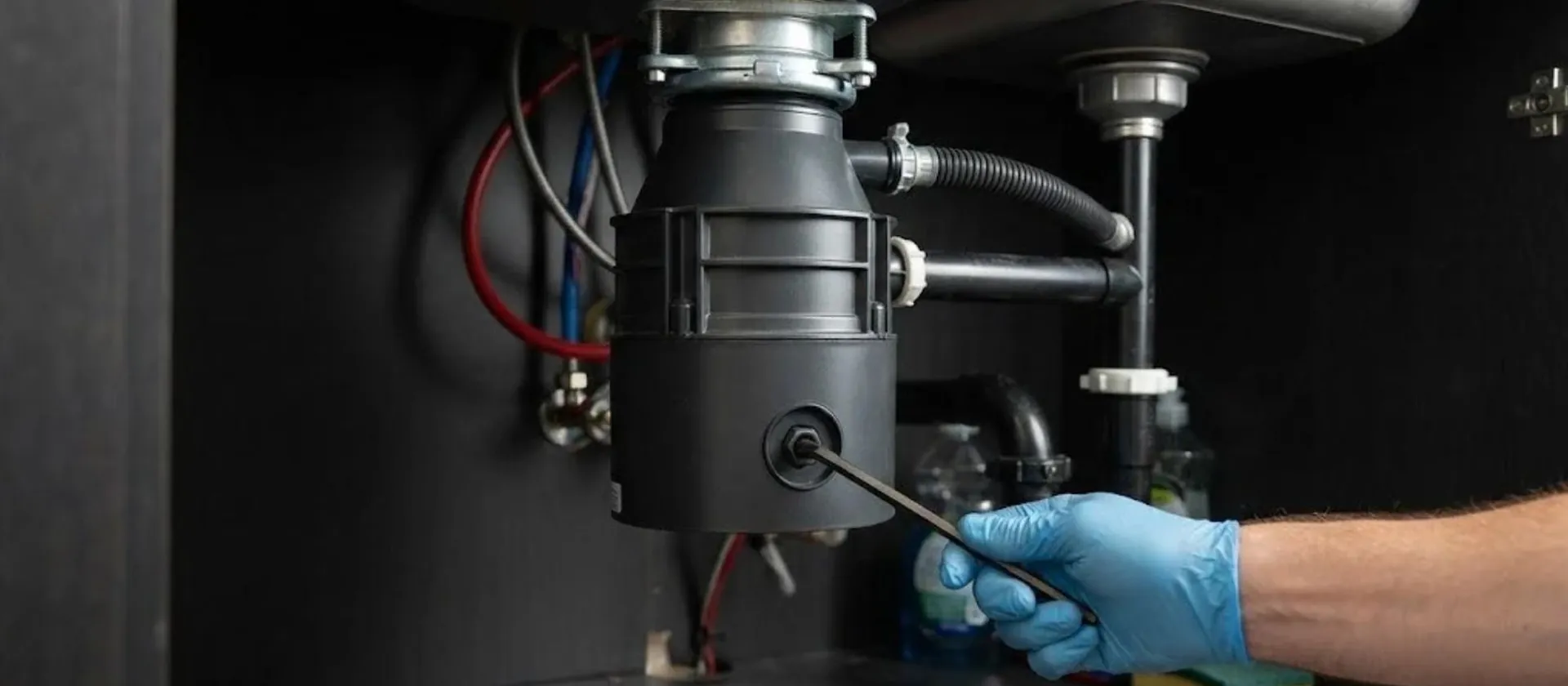
If your garbage disposal is humming but not turning, or water is leaking from under the sink, turn off the power at the switch and the breaker before you reach in. Never put your hand in the disposal, even when it is off. Our 24/7 line can help you decide whether this is something to wait on or a sink you need to stop using tonight.
Disposals fail in predictable ways. They jam, they leak, they stop running or they send water back up into the second basin. Each points to a different fix, and sometimes the clog is not in the disposal at all.
Reading the symptoms
Humming but not spinning
A jam. Something is lodged between the flywheel and the shredder ring. A hex wrench in the bottom socket can turn the plate back and forth to free it.
Silent, no hum
The unit has lost power. Check the reset button on the underside and the breaker. A tripped motor overload is common after a jam.
Water leaking underneath
A leak at the top flange, the dishwasher inlet or the bottom seam. A bottom leak means the housing has failed and the unit needs replacement.
Sink drains slowly or backs up
A clog in the trap or branch line. If the second basin fills, the blockage is past the disposal. See drain cleaning.
What not to do
Disposals injure people and wreck motors when treated carelessly.
- Do not reach into the disposal by hand, even with the power off.
- Do not pour drain cleaner into a jammed disposal. It sits in the unit and splashes when the crew works.
- Do not run the unit if it is leaking, because water can reach the motor and electrical connections.
- Do not force grease, bones, fibrous peels or large amounts of rice and pasta through the disposal.
Repair or replace
| Problem | Repair or replace | Notes |
|---|---|---|
| Jam cleared by turning the plate | Repair | Restart and test, check for damage. |
| Motor overloaded repeatedly | Often replace | Wear in the motor or shredder is likely. |
| Leak at the flange or inlet | Repair | Reseal or replace gasket and mounting. |
| Leak at the bottom seam | Replace | Housing has failed. |
| Rust, corrosion, grinding noise | Replace | Internal wear. |
| Unit older than about ten years with issues | Usually replace | Likely cheaper than repeated repairs. |
Installing a new disposal
A replacement disposal bolts to the sink flange and connects to the drain trap and the dishwasher line. Most sizes fit most sinks, but horsepower, noise and feed type vary. A continuous-feed model runs while you push scraps in. A batch-feed unit runs only when a stopper is in place. Larger units cost more and handle tougher scraps, but the best choice depends on how you cook.
We check the electrical connection, the dishwasher knockout plug and the drain. If a first-time install needs a new outlet or wiring, we tell you before the work starts. A sink without a disposal needs a switch and an outlet, which we can arrange.
Disposals in older and newer Saratoga kitchens
Kitchens in Saratoga range from older homes near the Village with original sink plumbing to newer custom kitchens with large island sinks. In older homes, the drain trap and the tailpiece often corrode, so we replace them when we swap the disposal. In newer kitchens with double basins and dishwashers, the dishwasher line and air gap are the usual leak points.
Hard water also plays a part. San Jose Water Company serves most Saratoga homes, and its groundwater runs roughly three times harder than Valley Water imported supply. Scale accumulates on the grinding parts and the drain. Running cold water while the unit operates and flushing afterward helps.
Insurance usually does not cover a worn-out disposal. If a leak damaged cabinets or flooring, the damage may be covered. Document it first.
Disposal jammed or leaking?
Turn off the power at the switch and the breaker, then call the 24/7 line.
Where we repair disposals
We serve Saratoga 95070 and the nearby towns of Los Gatos (95030, 95032), Monte Sereno and Campbell. For related problems see faucet repair. Details for the neighboring area are on our Los Gatos page.
Common Questions
Yes. The line is answered 24/7. If the unit is leaking, stop using the sink and cut power at the switch and breaker.
A hum with no spin means a jam. Power off, then turn the plate from below with a hex wrench. Never put your hand in the disposal.
The top flange, the dishwasher inlet and the bottom seam are the usual places. A bottom leak means the unit has to be replaced.
Many last around eight to twelve years. Hard water, heavy use and putting the wrong things in them shorten that.
Yes, if the sink has a standard drain opening. You also need a switch and an outlet, which we can add.
Grease, bones, fibrous peels such as celery and corn husks, and large amounts of rice or pasta. They clog the trap or wear the unit.
The drain past the disposal is partly blocked. A cable can clear it.
Yes. Removal is part of the visit.