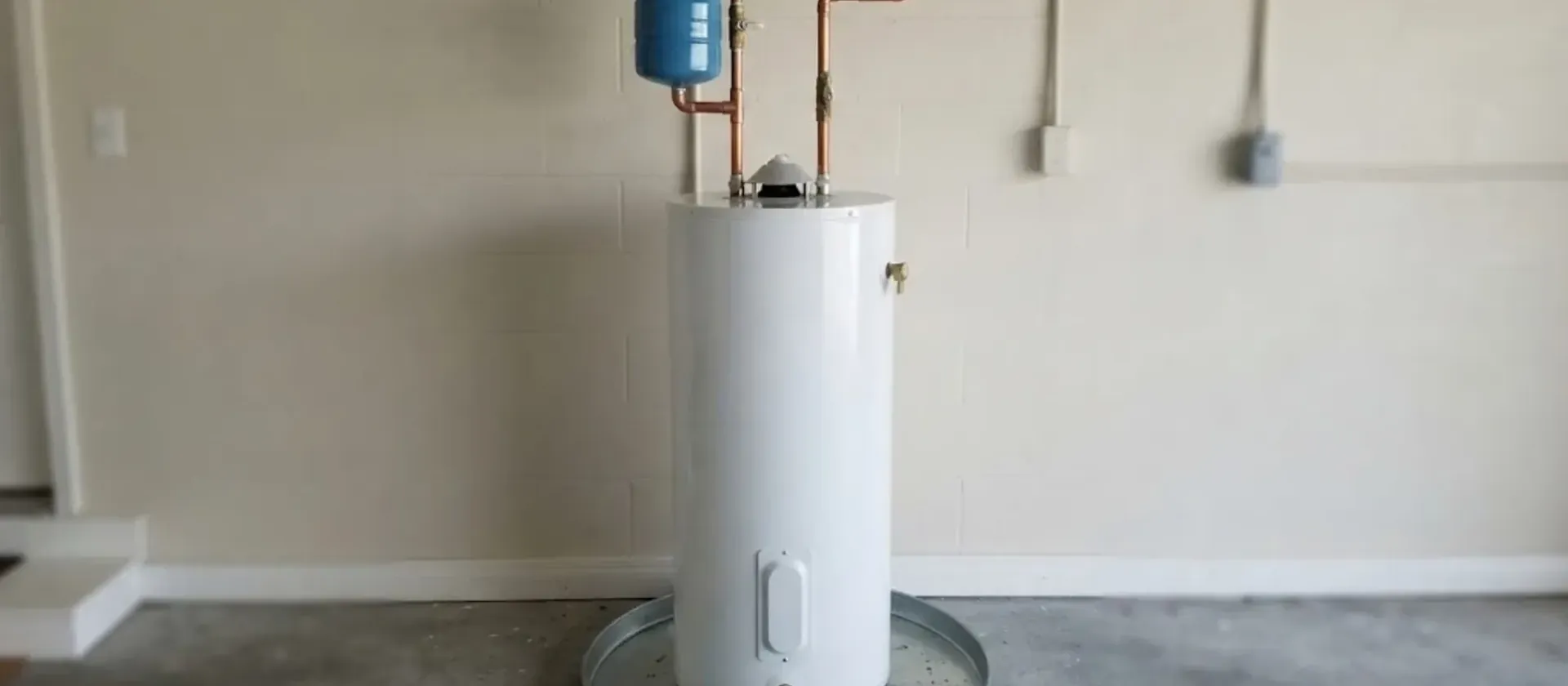
A tank water heater collects sediment on the bottom over the years. The sediment insulates the water from the burner or element, so the heater works harder, makes popping noises and wears out sooner. A flush drains the sediment before it builds into a crust.
You can flush most tank heaters yourself in under an hour. The steps differ for gas and electric models, and a heater that is already leaking or very old may not be worth flushing. Read the section on when to stop before you start.
What you need
Gather these first
Everything sits within reach of the heater.
- A garden hose long enough to reach a drain or the yard.
- A bucket for the first rush of sediment.
- Work gloves, since drained water is hot.
- A flathead screwdriver or a hose adapter for the drain valve.
Flushing a gas tank water heater
Turn the control to pilot
Set the gas control to pilot or off, so the burner does not fire while the tank is empty.
Close the cold supply
Shut the cold water valve above the heater.
Attach the hose
Connect the hose to the drain valve at the bottom, and run the other end to a safe drain.
Open the valve and a hot tap
Open the drain valve, then open a hot faucet in the house so the tank can drain fully.
Flush until clear
Briefly open the cold supply to stir the sediment, and repeat until the water runs clear.
Close the drain valve, remove the hose, open the cold supply and leave a hot tap open until water runs steady, which tells you the tank is full. Only then relight the pilot or return the control to its normal setting. If you smell gas at any point, leave the house and call 911 and PG&E at 1-800-743-5000.
Flushing an electric tank water heater
The steps are the same, with one critical difference: turn off the breaker for the heater before you drain it. Elements burn out fast if they are powered while exposed to air. Do not restore power until the tank is completely full and a hot tap runs a steady stream.
How often and what to look for
Plan to flush once a year, in the same month you check the smoke detectors. Write the date on the tank. If the water that comes out is milky, gritty or brown, sediment is heavy and a second flush a few months later may help.
Check three more things while you are there. Look at the temperature and pressure relief valve for corrosion or drips. Lift the lever briefly to confirm it moves freely and water drains to the pipe. Look at the anode rod if you have a wrench and the room for it. A rod worn to a thin wire means the tank walls are next.
What a flush does not fix
A flush cannot repair a tank that has already rusted through, and it will not bring back capacity lost to a failed dip tube or a dead element. If the water is still lukewarm or runs out fast after a flush, one of those parts is the likely culprit. Our technicians can test elements and thermostats on a visit.
It also will not remove scale from the pipes in the walls. That scale, if it is a problem, shows up as low pressure at every tap and calls for a different fix.
Set the temperature while you are there
Many heaters are set higher than needed. A setting around 120 degrees Fahrenheit is a common recommendation for households, and it lowers scald risk and energy use. If someone in the home is elderly, very young or immune compromised, ask their doctor what temperature is safe.
Never plug the relief valve
The California Plumbing Code (UPC-based) requires a temperature and pressure relief valve on storage water heaters, with a discharge pipe that runs downward to a safe spot. Do not cap, plug or shorten that pipe while you work. It is the last safety device if the thermostat fails.
Why flushing matters more in Saratoga
San Jose Water Company supplies most Saratoga homes. Its water quality report lists hardness by source, and groundwater reads roughly three times harder than Valley Water imported surface supply. The share at your tap depends on your street.
Practical meaning: harder water drops more minerals as it heats, so sediment builds faster on a heater fed by groundwater. A yearly flush is a reasonable habit on any Saratoga home, and homes with hard water may benefit from flushing more often. Tank heaters that last well past a decade often have a record of regular flushing.
California Health and Safety Code section 19211 requires water heaters to be braced, anchored or strapped. While you are at the heater, check that the straps are tight.
Sources: San Jose Water Company annual water quality report, California Health and Safety Code section 19211, PG&E gas safety guidance.When to stop and call a plumber
Stop if the drain valve is plastic and cracked, or if sediment blocks the valve so water will not flow. Do not force it. A stuck valve may need replacement, and an old tank may leak when disturbed. If you see rust around the base or water pooling, the tank may be near failure.
Call us for a flush if you prefer. Our water heater repair page lists what we check, and water heater replacement explains what to expect if the tank is past saving. Owners of tankless units should see tankless water heater service for descaling. For a cold-water flush that does not clear, ask about a water softener.
Neighbors in Los Gatos can see our coverage on the Los Gatos page.
Plumbing problem right now?
Call the 24/7 line and a dispatcher will plan the next step with you.
Questions Saratoga Homeowners Ask
Once a year is a common recommendation. Harder water may call for more often.
Yes if you follow the steps and take care with hot water. Turn off gas or power first.
Sediment traps water that boils. A flush often quiets it.
It can disturb sediment that was sealing a leak. If the tank is very old, ask a plumber first.
No. Tankless units use a descaling flush with a pump and solution. See our tankless page.