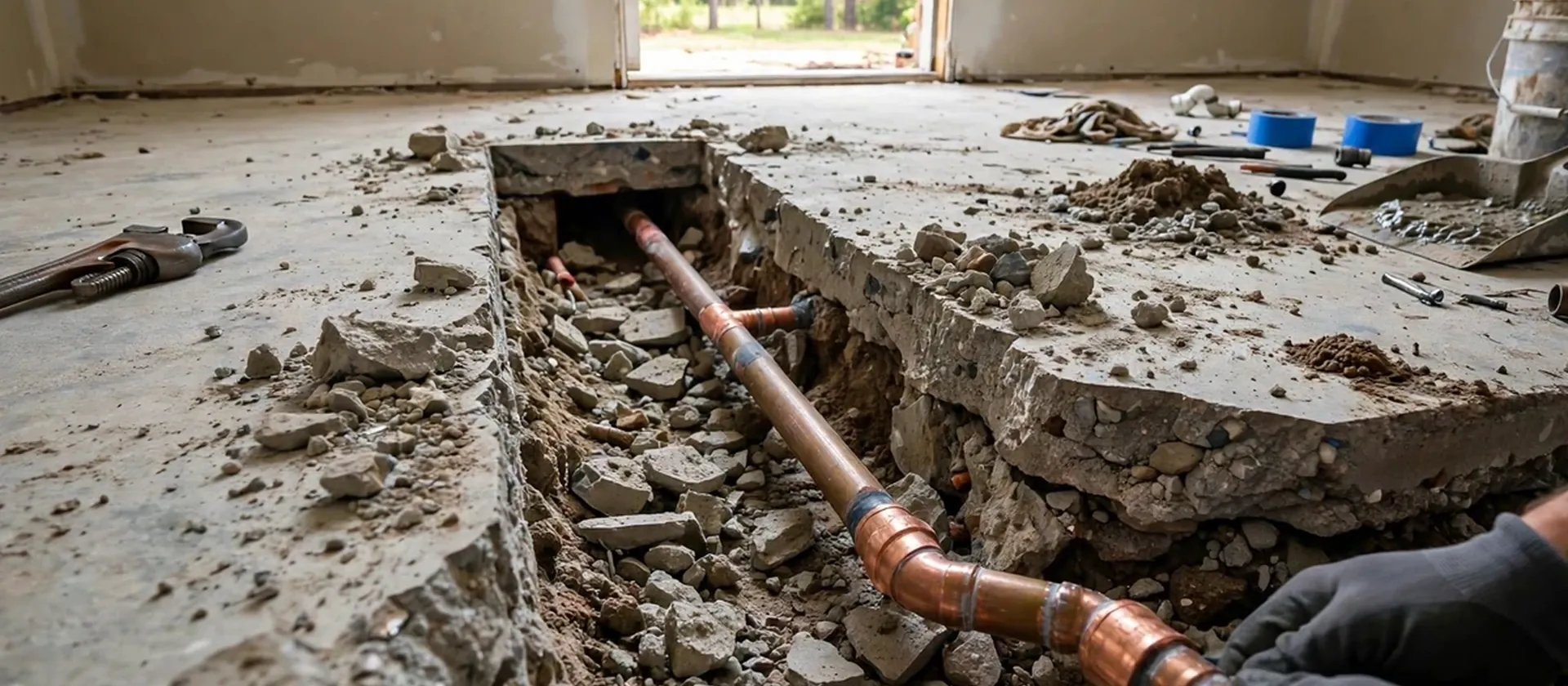
What a slab leak is and how to spot one
A slab leak is a leak in a water line that runs through or under a concrete foundation. In slab-on-grade homes, supply lines often run inside the slab or in the soil beneath it, so a pinhole or a failed joint has nowhere to go but into the ground.
Signs include a warm patch on the floor, the sound of running water when fixtures are off, a water bill that rises without explanation, damp baseboards and a meter that moves with everything shut. If you see active water, close the main and call our emergency line. For suspected leaks that are not yet damaging, we schedule a locate visit.
| What you notice | What it suggests | Next step |
|---|---|---|
| Warm spot on the floor | Hot water line leaking beneath the slab | Acoustic and thermal locate. |
| Meter spins with all water off | A supply leak somewhere, possibly under the slab | Pressure test by zone. |
| Sound of running water, no fixtures on | Pressurized leak in a wall or slab | Acoustic listening. |
| Damp carpet or cracked tile | Moisture reaching the surface | Moisture mapping and locate. |
| Rising bill, no change in use | Hidden supply leak | Meter check, then pressure test. |
Why slab leaks happen to Saratoga-area homes
Many houses built in the mid-twentieth century in the Santa Clara Valley sit on concrete slabs with copper piping beneath them. Copper can develop pinholes from the inside over decades. The condition of the water speeds the process. San Jose Water Company supplies most of Saratoga, and its groundwater reads roughly three times harder than Valley Water imported supply. Hard water leaves scale in pipes, and scale can speed pitting where water moves fast around a joint.
Movement matters too. Slabs shift and settle, and hillside soil can creep. A pipe that rubs against concrete as the slab moves wears through. Foothill lots with fill soil are more likely to settle unevenly. If your slab has new cracks or doors that now stick, mention it when you call.
Three ways to fix a slab leak
Spot repair through the slab
- Break a small opening in the concrete over the leak.
- Replace the damaged section of pipe.
- Patch the concrete and restore the floor.
- Best for one isolated failure on a sound line.
Reroute or repipe
- Abandon the leaking line under the slab.
- Run new pipe through the attic or walls.
- Avoids further digging under the floor.
- Best when multiple leaks or aging pipe are present.
Rerouting is often chosen when the pipe under the slab is old and has more than one weak point. You can read about whole-home options on our repiping page. If you are unsure whether the leak is under the slab at all, a leak detection visit confirms it first.
What happens during the repair
Confirm the leak
We test pressure, listen along the floor and use thermal imaging to isolate the line that is failing.
Mark the spot
The leak location is marked on the floor with a tolerance of a few inches, so the opening is as small as possible.
Open and repair
Where we cut the slab, we protect the surroundings, replace the damaged section and pressure test.
Restore and document
The concrete is patched. We give you the findings in writing, which your insurer may ask for.
Pressure testing after the repair
After any repair or reroute, the water piping is tested and proved tight, which is a requirement of the California Plumbing Code (UPC-based) for new and altered water piping. We pressure test before the slab is patched and again before we leave, so a second leak shows up while the floor is still open.
Insurance often covers the damage a slab leak causes but not always the cost of accessing the pipe. Coverage varies widely, so talk to your insurer early, and ask whether they need a leak report before work begins.
Think you have a slab leak?
Call to schedule a locate visit. If water is visible, close the main first and call the 24/7 line.
Where we work
We repair slab leaks across Saratoga 95070 and nearby Los Gatos (95030, 95032), Monte Sereno and Campbell. If a burst line is the problem, see burst pipe repair. The Los Gatos plumbing page has details for the neighboring area.
Common Questions
Common signs are a warm spot on the floor, running-water sounds with everything off, an unexplained bill spike or damp flooring. A meter check with all water off is the first test.
Often only a small opening is needed after the leak is pinpointed. Rerouting the line through the attic or walls avoids opening the slab at all.
If you see water at the surface, close the main and call right away. A hidden leak that is not damaging yet can wait for a scheduled visit, but it will not heal itself.
A spot repair can finish in a day. Reroutes and repipes take longer.
Insurance often covers resulting damage but may limit coverage for accessing and repairing the pipe. Check your policy and call your insurer early.
Water leaving a pipe can erode soil under a slab. Long leaks have been linked to settling. Early repair lowers the risk.
Hard water can contribute to scale and pitting in copper pipes. It is one of several factors, along with pipe age and slab movement.
Yes. Radiant heating lines can leak too. We use thermal imaging to separate heating leaks from supply leaks.