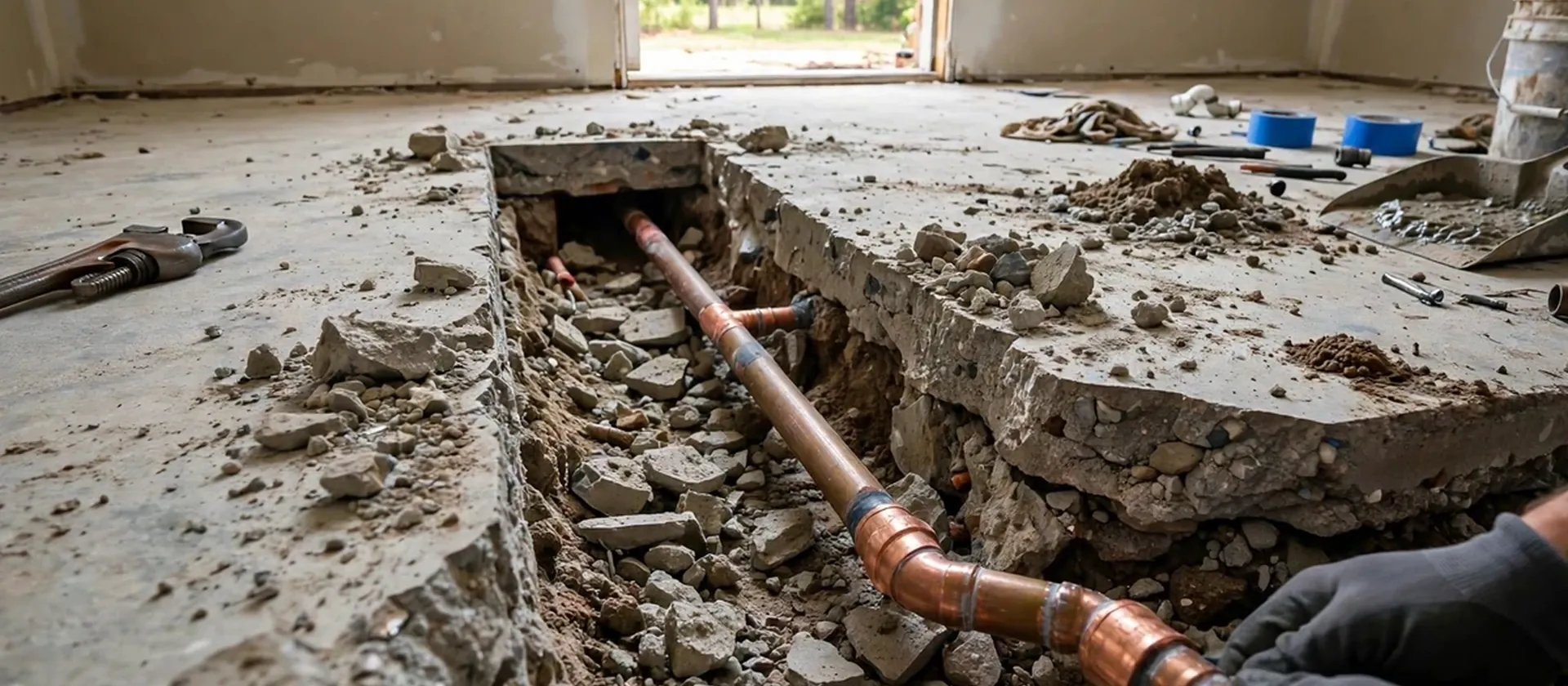
A slab leak repair costs what the method, the access and the floor finish add up to. A small spot repair under a bare concrete garage floor is a smaller job than a reroute through the attic of a finished home. Anyone who quotes a single number without seeing your house is guessing.
We give you a clear price before work starts. This guide explains what goes into it so you can compare quotes fairly. We have left out dollar ranges on purpose. They vary with the job, and a guessed range helps no one.
Cost factor one: how the leak is found
Finding the leak comes first. Pressure testing, acoustic listening and thermal imaging pinpoint the spot so we do not open more concrete than necessary. A leak that is obvious, like a warm patch directly under a hallway, is quicker to find than one that is faint and spread through several rooms.
Detection is usually quoted separately from repair, because some homeowners find the leak is not under the slab at all. Our leak detection page describes that step.
Cost factor two: the repair method
| Method | What is involved | Where cost comes from |
|---|---|---|
| Spot repair | Break concrete, replace a short section, patch | Concrete work and floor restoration. |
| Reroute | Abandon the slab line, run new pipe through walls or attic | Longer pipe run, drywall patching. |
| Repipe | Replace the whole supply system | Entire house scope, permit, inspection. |
The less often a line has leaked, the more a spot repair makes sense. A line with several pinholes usually points to reroute or repipe. Repiping costs more up front but ends the cycle of repeated leaks.
Cost factor three: floors and finishes
Concrete cutting is one cost. Restoring the floor above it is another. Tile may need to be matched, hardwood has to be repaired and carpet can be lifted and reset. In older homes, tile may be discontinued, which makes a clean match hard.
Ask whether the quote includes patching the floor finish or only the concrete. Many plumbers stop at concrete, and a flooring contractor finishes the job. Knowing that up front prevents surprises.
Cost factor: how many leaks and how old the pipe
One pinhole on a thirty-year-old copper line is a warning, not a one-off. Pipes of the same age and material tend to fail in sequence. If a camera or a pressure test suggests the rest of the line is thin, a reroute may cost less than paying for one repair, then another, then another.
Ask your plumber what they saw. A clean repair on a pipe that otherwise looks healthy tells one story. A pipe with green stains and thin walls tells another. Good quotes explain which story applies.
Questions that keep a quote honest
Is detection included or separate? What happens if the first spot is wrong? Who pays for the second opening in the slab? Is the permit included? Is flooring included? Does the price change if a second leak is found?
A plumber who answers these plainly before starting is giving you a real quote. One who cannot is giving you an estimate with open ends.
What the code requires after the repair
The California Plumbing Code (UPC-based) requires new and altered water piping to be tested and proved tight. Ask whether your quote includes the pressure test and any inspection, because a repair that skips testing can leak again after the floor is patched.
Saratoga houses and slab leak risk
Some older homes across the Santa Clara Valley sit on concrete slabs with copper lines under them. Copper can pit from the inside, and San Jose Water Company reports hardness by source, with groundwater reading roughly three times harder than Valley Water imported surface supply.
Practical meaning: a home on a harder supply may see pitting sooner, and a hillside lot with shifting soil can stress pipes. If your slab has new cracks or your floor feels warm in one spot, test the meter with all water off and call. Early repair costs less than repairing after a flood.
The City of Saratoga building division can confirm permit requirements for reroutes and repipes at your address.
Sources: San Jose Water Company annual water quality report.Cost factor four: permits and inspection
Spot repairs often do not need a permit. A reroute or repipe usually does. Permit fees depend on the scope. We handle the permit and the inspection and include them in the quote so there is no separate bill.
What insurance may cover
Many homeowners policies cover the damage a slab leak causes but limit coverage for reaching and repairing the pipe. Some cover tear-out costs, and some do not. Policies differ widely, so ask your insurer before work starts and ask whether they need a written leak report.
We provide a written report of what we found and where. Keep photos of any damage, and keep the failed pipe section if we remove it, because adjusters sometimes want to see it.
How to get a fair quote
Ask for an itemized quote that separates detection, repair, permits and restoration. Ask which method is proposed and why. Ask what happens if more leaks turn up. Our slab leak repair page lists the steps we follow, and burst pipe repair covers the emergency side.
Los Gatos homeowners can read how we cover that area on our Los Gatos page.
Plumbing problem right now?
Call the 24/7 line and a dispatcher will plan the next step with you.
Questions Saratoga Homeowners Ask
It depends on the method, access and floor finish. We give a clear price before work starts and itemize the parts.
Often for resulting damage, less often for reaching the pipe. Check your policy and ask early.
A single leak is usually cheaper to repair in place. Multiple leaks often make a reroute better value.
A reroute or repipe usually does. Ask the City of Saratoga building division about your address.
Long leaks can erode soil under a slab, so early repair lowers the risk.