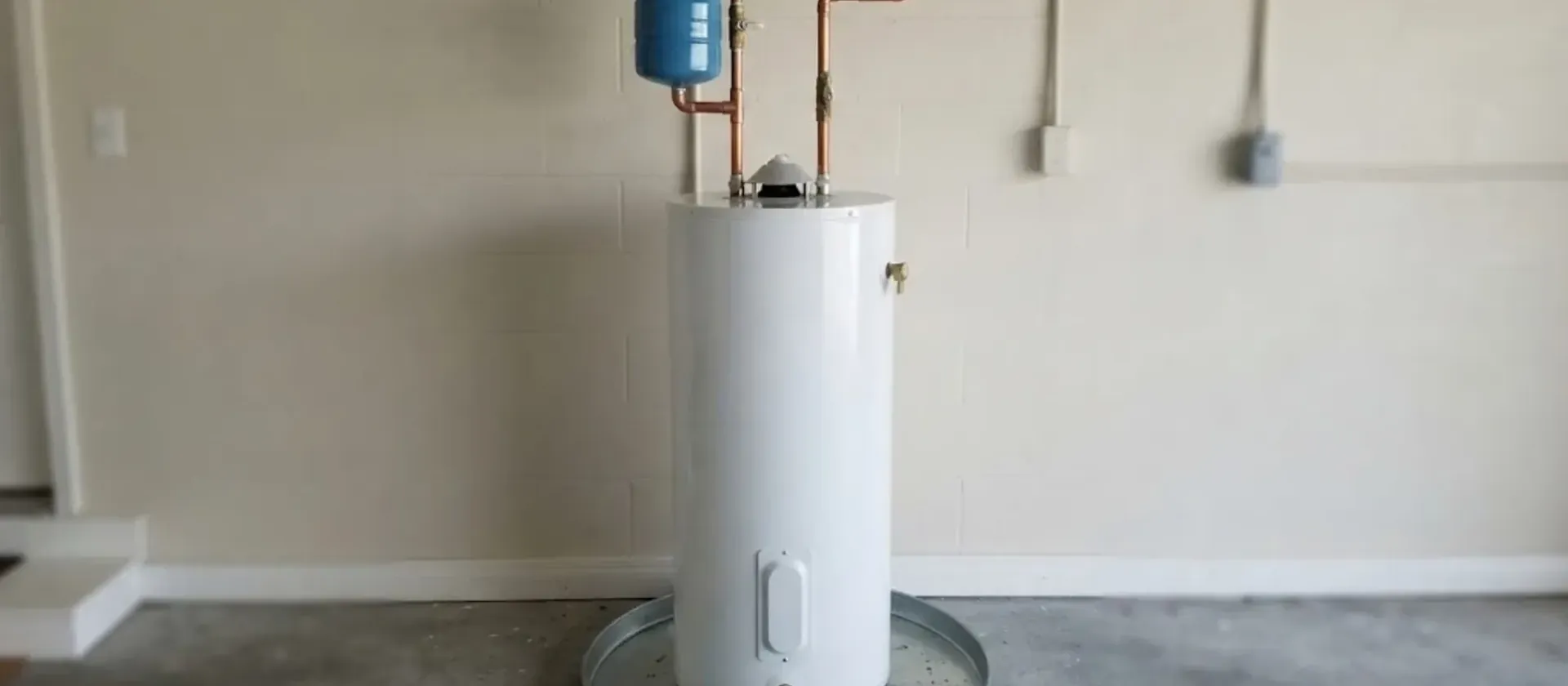
When water is heated, it takes up more space. In an open system, the extra water pushes back into the city main. In a closed system, where a backflow preventer or a pressure-reducing valve stops it from going back, the water has nowhere to go. The pressure rises each time the heater fires.
An expansion tank gives the extra water a place to go. It is a small tank, often on the cold supply line near the heater, with a rubber diaphragm and a cushion of air. Without one, repeated pressure spikes strain the heater, the pipes and the fixtures, and the relief valve may drip.
Signs your system may need one
The relief valve drips
A temperature and pressure relief valve that drips when the heater fires may be reacting to thermal expansion.
Banging pipes when the heater runs
Pressure surges can cause noise and wear on fittings.
Short heater life
Repeated pressure spikes stress the tank. An expansion tank is cheap insurance.
A new closed system
Pressure regulators and backflow preventers close the system. Many homes have one.
How to tell if your system is closed
Most modern homes in this area have a pressure-reducing valve where the water line enters the house, and many have a backflow preventer at the meter. Either one can close the system. A gauge on a hose bib shows pressure. If the pressure rises sharply when the heater fires, the system is closed.
Your plumber can confirm in minutes. If you already have an expansion tank, check it. A waterlogged tank has lost its air cushion, and the pressure problem returns.
Installing the tank
Size the tank
Tank volume and house pressure decide the size. Most homes use a two-gallon tank, but larger heaters need more.
Shut off and drain
Close the cold supply and the heater, then drain a few gallons to relieve pressure.
Set the air charge
Before you install, set the tank's air pressure to match your house pressure, using a gauge and a pump.
Connect and support
Thread the tank onto a tee on the cold line, then support it so its weight does not strain the pipe.
The air charge is the step most often missed. A tank shipped at the factory pressure will not match your house. If it is set too low, it fills with water and does nothing. If it is too high, it cannot accept the expansion. Match the setting to your static pressure.
Choosing and sizing the tank
Expansion tanks are rated by the volume of water they can accept. A tank for a forty to fifty gallon heater is usually small, about two gallons. A larger heater, a recirculation loop or high incoming pressure may need a bigger one. Using a tank that is too small leaves you with the same pressure spikes.
Buy a tank rated for potable water, with a diaphragm that is sealed from the tank wall. Check the maximum pressure rating against your house pressure. A tank rated for lower pressure than your system sees will fail early.
Check your house pressure first
Screw a pressure gauge onto a hose bib and read it with all taps off. Many plumbers aim for a range that protects fixtures and appliances. If your reading is high, a pressure regulator should be installed or adjusted first. An expansion tank handles thermal expansion. A regulator handles high supply pressure. They solve different problems and often work together.
The code requirement behind the tank
The California Plumbing Code (UPC-based) requires thermal expansion to be controlled where a storage water heater sits in a closed system. An expansion tank is the common way to meet it. Inspectors often look for it when a heater is replaced.
Pressure, hillsides and California rules
Saratoga streets run from valley floor to steep foothills. A home lower on a slope can see higher static water pressure than a home higher up, so a regulator and a gauge are worth having. San Jose Water Company supplies most Saratoga homes.
Practical meaning: if your house pressure is high, say above the range plumbers aim for, a regulator protects fixtures, and the regulator also closes the system. That makes an expansion tank more likely to be needed.
California Health and Safety Code section 19211 requires water heaters to be braced, anchored or strapped. An expansion tank hangs on the supply line, so check that the pipe and the tank are supported and that the tank does not pull on the water heater connections during a quake.
Sources: California Health and Safety Code section 19211. San Jose Water Company service information.Permits and code
Expansion tanks are common code items on new water heater installations. If you are replacing a heater, the inspector may ask for one. The City of Saratoga building division and the Town of Los Gatos can tell you what applies. We add the tank, set the pressure and note it on the permit when one is required.
See our water heater installation and water heater replacement pages for the full scope, and water heater repair if your relief valve is dripping now.
How long they last
Expansion tanks typically last several years, but the diaphragm can fail. Signs are water coming out of the air valve, a tank that feels heavy and a return of pressure spikes. Replace the tank rather than attempting to repair it. Check the air charge once a year when you flush the heater.
Los Gatos homeowners can read how we handle this in the Los Gatos page.
Plumbing problem right now?
Call the 24/7 line and a dispatcher will plan the next step with you.
Questions Saratoga Homeowners Ask
Not all. They are needed where the plumbing is a closed system. A plumber can check your pressure behavior.
On the cold water line near the heater, supported so its weight does not strain the pipe.
Match it to your house static pressure. Measure with a gauge, then set the tank with a pump before installing it.
Thermal expansion is a common cause. A worn valve or high pressure can also cause it.
Press the air valve. Water coming out means the diaphragm has failed.