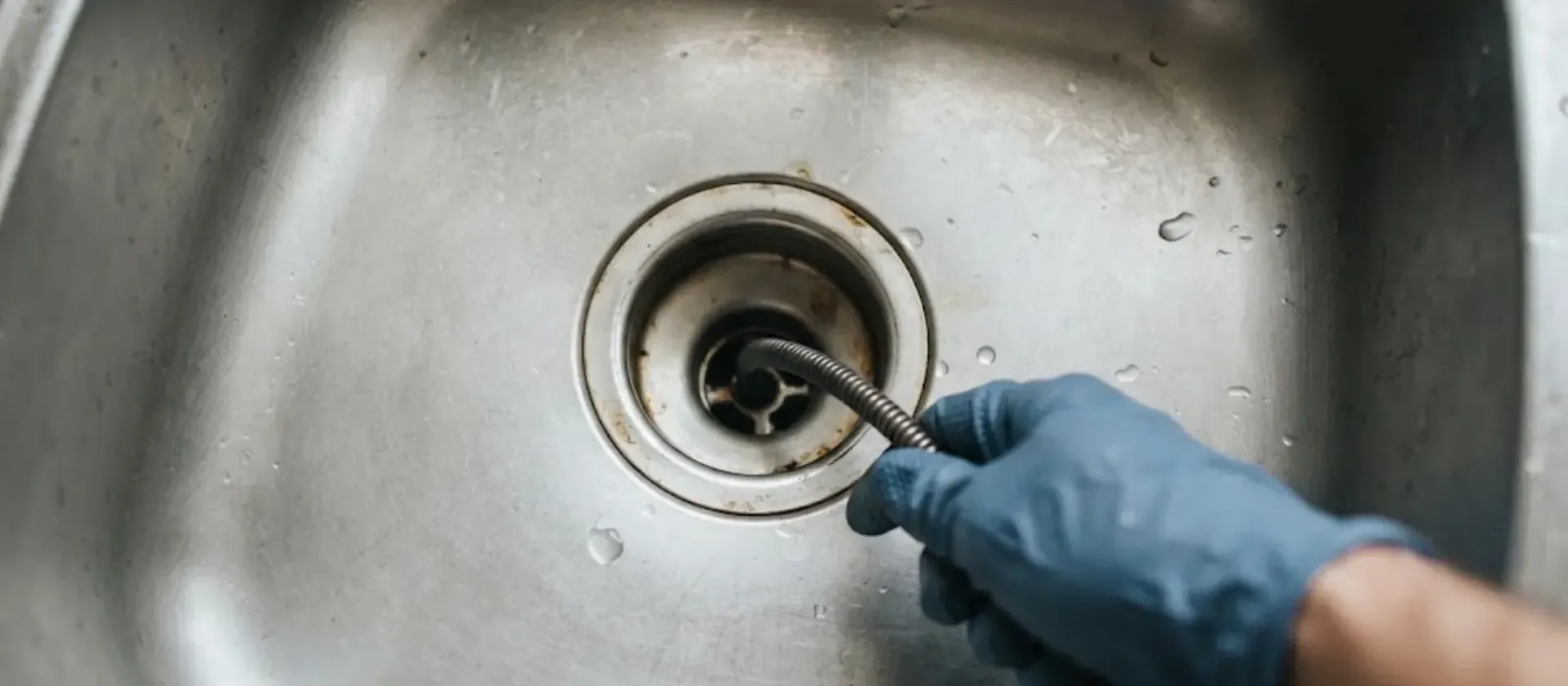
A plumbing snake, also called a drain auger, is a flexible steel cable with a corkscrew tip. You feed it into the drain, crank it to hook or break up the clog and pull the debris out. It is the next step after a plunger and the last thing most homeowners should try before calling a plumber.
The right tool depends on where the clog is. A small hand-crank auger reaches about twenty-five feet in a sink or tub drain. A toilet auger is shorter and has a protective sleeve for the porcelain. Neither is meant for a main sewer line.
Choose the right snake
| Tool | Use for | Avoid on |
|---|---|---|
| Hand-crank drain auger | Sink, tub or shower drain | Main sewer line. |
| Toilet auger (closet auger) | Toilet bowl clogs | Sinks and tubs. |
| Drain stick (plastic) | Hair in tub and shower drains | Deep clogs. |
| Power drum machine | Main lines and long runs, by a professional | Fragile or damaged pipe. |
How to snake a sink or tub drain
Prepare
Remove the stopper or strainer, put on gloves and lay down towels. Bail standing water if you can.
Feed the cable
Push the tip into the drain until you feel resistance. Tighten the thumbscrew and begin cranking.
Work the clog
Crank slowly and push gently. When the cable breaks through, you will feel it give. Pull the cable back slowly to bring debris out.
Flush and test
Run hot water for several minutes, and clean the cable before putting it away.
Do not force the cable. A cable that stops hard and will not turn may have hit a bend or a fitting. Pushing harder can kink the cable or scratch the pipe. Back off, rotate and try again, or stop and call.
Snaking a toilet
Use a closet auger, which has a curved tip designed for the toilet trap. Insert the tip into the bowl, crank the handle and push gently until you feel the clog. Pull back, and flush to test. Never use a drain cable on a toilet, because it can scratch the porcelain.
If the toilet backs up again right away, the blockage may be past the toilet, in the branch or the main. See our toilet repair page and the signs below.
Technique that saves your pipes
Keep the cable straight as you feed it, and let the spinning tip do the work. Pushing hard makes the cable buckle inside the pipe. When you hit a bend in the trap, rotate the cable and ease through. Every sink trap has at least one tight bend.
Pull the cable out slowly while still turning it. This hooks and drags debris out. Rinse the cable in a bucket or a utility sink, not the kitchen sink. Keep a bag nearby for the hair and grease that comes out. It is not pleasant, and it is the proof the job worked.
Common signs the clog is bigger than your snake
The cable runs out of length before it meets resistance. The cable meets resistance at the same spot every time and will not pass. You pull out roots or slime that looks like part of a larger mass. The water drains for a day and then backs up again. In each case a bigger machine and a camera are the next move.
Safety checklist when you snake a drain
A snake is simple, and it is still a machine with a spinning tip.
- Wear gloves and eye protection, since debris and water can spray back.
- Never use a snake on a drain with chemical cleaner in it.
- Keep your hand off the spinning cable. Hold the handle, not the cable.
- Wash your hands and the cable with soap and water afterward.
What a snake can run into in Saratoga
West Valley Sanitation District serves part of Saratoga, according to the Santa Clara County LAFCO service review, and asks residents to keep grease and wipes out of the sewer. Hand augers handle fixture clogs but will not reach the main line on a long hillside lateral.
Practical meaning: many Saratoga lots are sloped and wooded, with long laterals that run under trees. If several fixtures back up at once, tree roots or a damaged lateral are possible, and a homeowner snake will not reach far enough.
Older homes near the Village along Big Basin Way may have clay or cast iron drains with rough interiors that catch debris. A thin snake can snag in old pipe. If you feel it catch repeatedly at the same distance, stop.
Sources: Santa Clara County LAFCO service review.When to stop and call
Call when more than one fixture is affected, when the cable hits resistance you cannot get through, when water backs up into a tub or floor drain or when sewage appears. These signs point to the main line. Stop using water and call the 24/7 line.
Our drain cleaning page explains how professionals use heavier cables and jetters, and sewer line cleaning covers the main line. A camera inspection shows what the clog is made of and where the pipe may be damaged.
Care and safety
Wear gloves and eye protection. Wash your hands afterward. Never use a snake on a drain that contains chemical cleaner, because the liquid can splash back. Clean and dry the cable before storage to prevent rust.
If a clog keeps returning after you snake it, something is catching in the pipe, and you will be snaking forever. Los Gatos readers can see our Los Gatos page.
Plumbing problem right now?
Call the 24/7 line and a dispatcher will plan the next step with you.
Questions Saratoga Homeowners Ask
Most reach around twenty-five feet. That is enough for a fixture drain, not a long sewer lateral.
Yes, if forced or used on fragile pipe. Go slowly and stop if it catches.
Yes. It has a sleeve to protect the porcelain and a curved tip for the trap.
A snake opens a channel but does not scrape the pipe. Grease or scale remains. Jetting or a camera helps.
No. Chemicals can splash when you snake and add risk.