When sewage comes up through a tub, shower or floor drain, stop using water in the whole house and call. Our line is answered 24/7. A damaged sewer line is a health hazard as well as a plumbing failure, and every flush or load of laundry adds more water to a pipe that cannot carry it away.
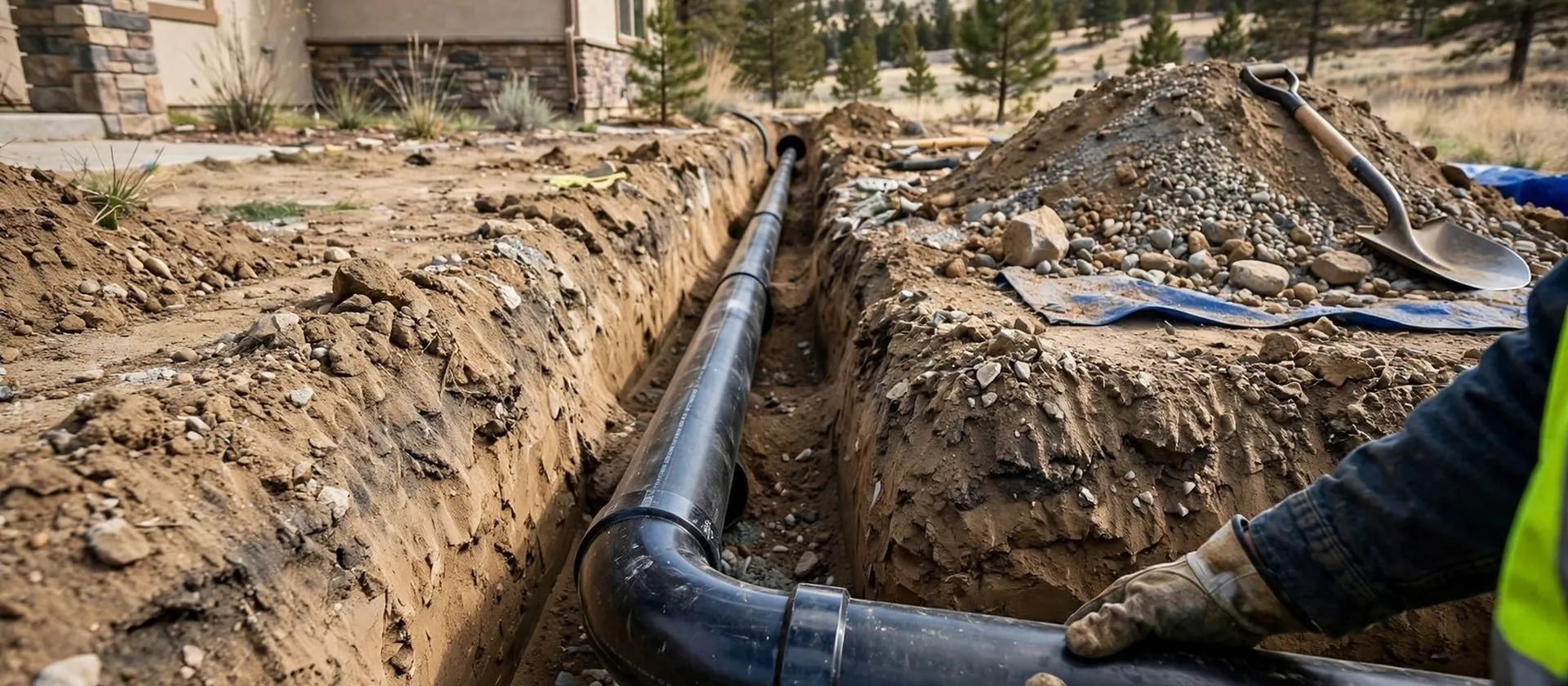
Cleaning a line gets water moving again, but it does not fix a broken pipe. If a camera shows a crack, a sag or a collapsed section, the repair is what ends the cycle of backups. Below is how we diagnose, how we choose between digging and lining, and what to do in the first hour.
Signs the sewer line itself is damaged
Backups that return after cleaning
A line that clogs again within weeks is often catching on a crack, an offset joint or a root mass. The cleaning treated the symptom, not the cause.
Soggy patches or odors in the yard
Wet ground along the lateral path on a dry day, or a sewer smell near the cleanout, suggests the pipe is leaking into the soil.
Gurgling and slow drains throughout
When toilets, tubs and sinks all drain badly together, the main line is restricted somewhere between the house and the connection.
Sinking ground or cracked slab
Water leaving a broken pipe can wash soil away. New dips in a lawn or hairline cracks in a concrete slab deserve a camera look.
First hour checklist for a sewage backup
Quick action protects floors and keeps the family safe.
- Stop using all water, including toilets, showers, sinks, the dishwasher and the washing machine.
- Keep children and pets out of any room with sewage on the floor.
- Do not run a cleaner or pour chemicals into the drains. The pipe may be broken, and chemicals add risk without helping.
- Photograph the backup and any damage for your insurer before cleanup starts.
Finding the break: camera first
A sewer camera on a flexible rod travels from the cleanout through the lateral and records what it sees. It shows cracks, offset joints, root intrusions, sags that hold water and collapsed sections. It also measures how far from the cleanout the problem sits, which lets us plan the repair around trees, driveways and patios rather than guessing.
We show you the footage and explain what it means. If a planned inspection is all you need, our sewer camera inspection page covers that service on its own. If the camera shows only buildup, hydro jetting may fix the problem without any repair at all.
Dig, spot repair or line it
| Method | Best when | Trade-offs |
|---|---|---|
| Spot repair (open trench) | One short broken section, easy access | Digging is required, but only for the damaged stretch. |
| Full replacement | Long runs of collapsed, bellied or deteriorated pipe | Most disruptive, longest lasting, may need permits and landscape repair. |
| Cured-in-place pipe lining | Cracked or root-infiltrated pipe that still holds its shape | Little or no digging, but not suitable for collapsed or badly offset pipe. |
| Pipe bursting | Aged pipe where a new line can follow the old path | Minimal trenching, needs access pits at both ends. |
When lining makes sense
- The pipe is intact but has cracks or open joints.
- Roots are entering at the joints.
- Digging would disturb a driveway, a patio or mature trees.
- The camera shows a smooth path with no major sags.
When digging is the better answer
- A section has collapsed or lost its shape.
- The line has a belly that holds water.
- Pipe material has broken down along a long run.
- A connection to the main needs to be rebuilt.
What Saratoga lots mean for sewer repair
Saratoga streets climb into the Santa Cruz Mountains foothills, and lots often feature steep drives, retaining walls and large trees. A lateral that runs under any of those makes trenchless methods more attractive. The City of Saratoga manages the public right-of-way, and work near the street can require a permit. Ask the building division about your address, and we handle the paperwork for jobs that need it.
Sewer service comes from more than one agency. Part of the city is served by West Valley Sanitation District, according to the Santa Clara County LAFCO service review. Responsibility usually divides at the connection to the public main, where the property owner is responsible for the lateral running from the house. A camera run tells us which side of the line a break sits on, and we tell you who needs to be called.
Older homes near the Village and along the main roads may still have clay or cast iron laterals. Clay joints separate and let roots in, and cast iron rusts from the inside out. Newer homes in the Golden Triangle typically have plastic pipe, which fails in different ways, often from settling or poor bedding.
Homeowners insurance usually excludes damage from a sewer line failing from age or wear, but sewage backup riders and some endorsements may cover cleanup. Ask your insurer which applies and send them the camera footage.
Sewage backing up now?
Call the 24/7 line. Stop using water and tell the dispatcher which drains are affected.
Related services
If a line is badly clogged but not broken, sewer line cleaning clears it and sets up a maintenance plan. For ordinary backups from a single fixture, see drain cleaning. We repair sewer lines across Saratoga 95070 and in Los Gatos 95030 and 95032, covered on the Los Gatos page.
Common Questions
The line is answered 24/7. We can clear a backup and run a camera right away. Excavation and lining are scheduled after the line is stable and the repair plan is clear.
A clog usually clears with cabling and stays clear. A broken line backs up again, often at the same spot. A camera run shows whether the pipe is cracked, offset or collapsed.
Not always. Pipe lining and pipe bursting reduce digging. Collapsed pipe and some bellied runs still need an open trench. We explain which applies after the camera run.
Property owners are generally responsible for the lateral from the house to the public main. The camera footage shows which side of the connection the damage is on.
Many policies exclude failure from age or wear. Some cover sudden backup damage or offer a rider. Call your insurer and keep the camera footage and invoices.
Lining and small spot repairs can finish in a day or two. Full replacements take longer depending on length, depth and permits.
Work on the public connection or in the right-of-way generally does. Ask the City of Saratoga building division about your address. We handle permits where required.
Lining seals the joints roots use to get in. Spot repairs fix one point. Roots from a nearby tree can still find other joints, which is why we check the whole line on camera.